 |
Ed Murphy North Dakota Geological Survey 600 East Boulevard Avenue Bismarck, N.D. 58505-0840 U.S.A. |
Several attempts have
been made in North Dakota, starting in the early 1890s, to produce natural
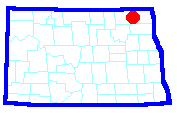
cement. From 1899 to 1909, a natural cement plant operated west of the
town of Concrete in eastern Cavalier County. The plant baked high lime
shales from the Niobrara Formation in kilns and ground and packaged the
resulting natural cement. This natural cement had a hard time competing
with the superior grades of portland cement and the plant closed. |
|
The rocks in several other areas in both western
and eastern North Dakota have been investigated for their potential
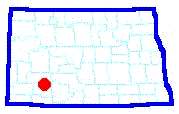
use in making natural cement. Ten carbonate-capped buttes in eastern
Stark and Hettinger counties were studied to determine their suitability
in the manufacturing of natural cement. In northeastern North Dakota,
"high lime zones" within the Niobrara Formation in Walsh and Grand Forks
counties were investigated, as were Paleozoic carbonates at depths of
a few hundred feet below the Red River Valley. |
|
Other than the
short lived plant at Concrete, the carbonates in North Dakota have not
been utilized in the manufacturing of natural cement. |
|
 |
 |
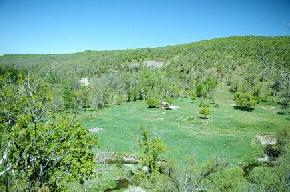
The clearing
in the foreground is the site of the old Portland Cement Company plant
near Concrete in eastern Cavalier County. Shales from the Niobrara and
Pierre formations are exposed along the hillside in the background. The
remains of the kilns used to bake the high lime shales are present near
the center of the photograph. (Photo by E. Murphy, NDGS). |
|
 |
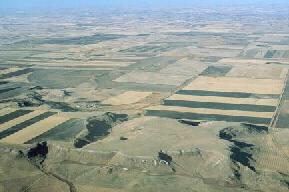 |
Aerial
photograph of White Butte in northern Hettinger County. White Butte is
typical of the twenty or so flat-topped, white rimmed buttes in this area.
These buttes are capped by 1 to 10 foot thick beds of freshwater carbonates
that occur in the South Heart Member of the Chadron Formation. (Photo by E. Murphy, NDGS). |
|
 |
 |
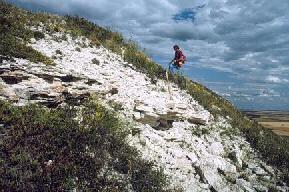
The freshwater
carbonate caprock of South Lime Hills in southeastern Stark County. The
carbonate caprock in this area was investigated in the 1940s and 50s for
utilization in the production of natural cement. (Photo by E. Murphy, NDGS). |
|
|
|