Bison
latifrons Ice age mammals of North Dakota Exhibit at the North Dakota Heritage Center |
||||||
 |
||||||
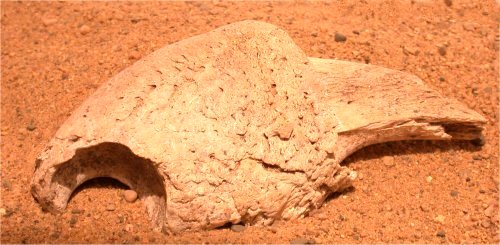
Bison latifrons skull The
scientific name Bison latifrons is derived
from the Greek language and refers to this bison's broad cranium
and large horns. They were huge animals, the largest of all North
American bison with horn cores that spanned over 200 cm compared with
horn core spans of about 65 cm for the living North American bison. They
were about 25% larger than the living bison. Bison latifrons inhabited
North Dakota during the last Ice Age at the same time that mammoths
and mastodons lived here. Bone from this fossil was radiocarbon
dated indicating that it is over 47,500 years old. Bison latifrons inhabited
forest openings/woodland areas unlike the grassland-dwelling modern
bison. They lived in small groups unlike the herding modern bison. Bison
latifrons became extinct during the last Ice Age several thousand
years ago. |
||||||
|
||||||
|
||||||
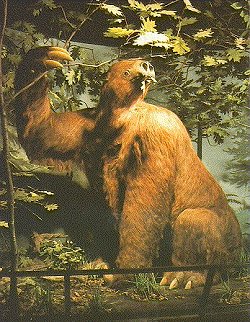
The scientific name of the giant ground sloth or Jefferson's ground
sloth, Megalonyx jeffersonii, is derived from the Greek language
and refers to the large claw on the third digit of each of the sloths
hind feet. Thomas Jefferson, a paleontologist amongst other things,
gave the name Megalonyx to these giant ground sloths in a 1797
presentation to the American Philosophical Society. It was later
given the name Megalonyx jeffersonii in honor of Thomas Jefferson. |
||||||
|
||||||
|
||||||
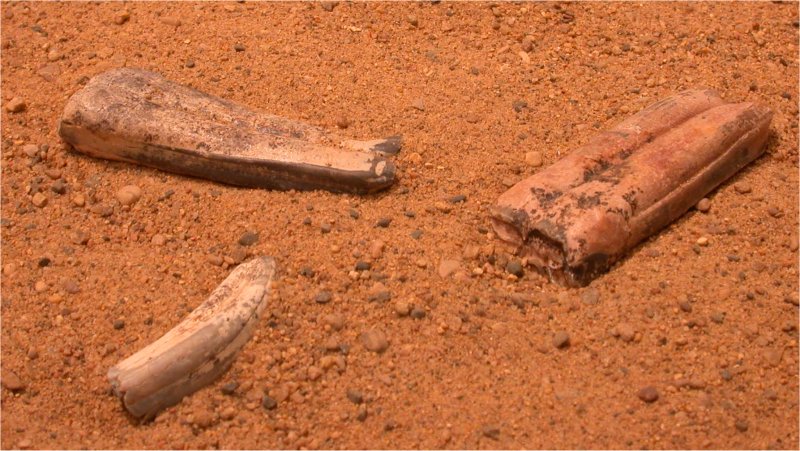
Equus sp., teeth The
scientific name Equus is derived from
the Latin language and means horse. Horses have lived in North
Dakota for at least 30 million years. The early horses, such
as Mesohippus, where small animals about the size of sheep and
had three toes on each foot. They possessed low crowned teeth
and were browsers. Equus sp., similar to today's horse,
lived in North Dakota at the end of the last Ice Age about 11,000 years
ago. They had one toe on each foot and high crowned teeth adapted for
eating grasses like today's horse. Equus sp. ranged widely over
North America at that the end of the Ice Age but became extinct in
North America several thousand years ago. It is not known why
they became extinct in North America. Horses were reintroduced
into North America by the Spaniard Cortez in 1520. |
||||||
|
||||||
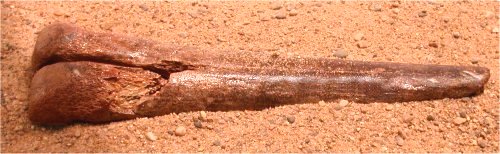
Camelus? sp. metatarsus The
scientific name Camelus is derived
from the Latin language and means camel. Small, goat-sized camels
lived in North Dakota about 30 million years ago. This metatarsus
(foot bone) is however from a camel that inhabited North Dakota during
the last Ice Age. It would have been about the size of a llama. These
camels became extinct in North America several thousand years ago. |
||||||
|
||||||
|
||||||
Acknowledgments We thank Kent Pelton, Linda and Doug Vannurden, and David Johnson for calling to our attention the fossils in this exhibit that they discovered. We also thank the U. S. Army Corps of Engineers, Omaha District and Three Affiliated Tribes for allowing us to display the Bison latifrons skull and the U. S. Army Corps of Engineers, Omaha District, Garrison Project for providing funding for the exhibit. |
||||||
|
||||||
|