|
| |
Geology
and Prehistoric Life of the Rendezvous Region |
|
John
W. Hoganson & Johnathan M. Campbell
North Dakota Geological Survey
600 East Boulevard
Bismarck, North Dakota 58505
Brian
R. Austin
State Historical Society of North Dakota
612 East Boulevard
Bismarck, North Dakota 58505 |
|
|
|
|
|
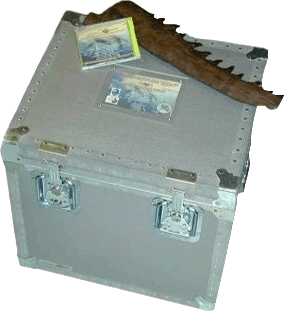
For information on obtaining the actual
Education Trunk for your classroom, contact:
Henry Duray
Icelandic State Park
13571 Highway 5
Cavalier, ND 58220
(701) 265-4561
isp@state.nd.us |
|
|
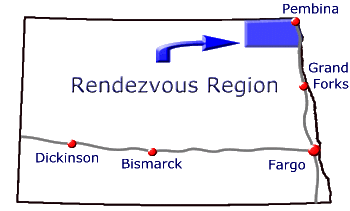
Location
of the Rendezvous Region in North Dakota |
INTRODUCTION:
The Geology and Prehistoric Life of the Rendezvous Region traveling education
trunk, accompanying CD and this web site are meant to provide information
about the geology and paleontology of Cavalier and Pembina Counties, North
Dakota. This area is often referred to as the Rendezvous Region
because large rendezvous were held there during the fur trade era.
The Rendezvous Region is one of the most scenic areas in the state, and
it is also one of the most interesting areas from geological and paleontological
perspectives. The oldest rocks in North Dakota are exposed in the
Pembina Gorge and North Dakota's oldest fossils are found in those rocks.
The rocks and fossils entombed in them provide evidence that North Dakota
was covered by shallow seas from about 90 to 80 million years ago and
that these seas were teeming with life. The last Ice Age, that ended
just a few thousand years ago, is documented by landforms produced by
glaciers in the Rendezvous Region. Warming of climate, which resulted
in melting of glaciers at the end of the Ice Age, produced glacial Lake
Agassiz. Lake Agassiz covered the Red River Valley. The terrain
is extremely flat in most of Pembina County because the area used to be
the bottom of this lake. Beach ridges, the shorelines of Lake Agassiz,
are still present in western Pembina County. |
 |
| View
of the roadcut through the promising fossil site in the Pembina
Gorge. |
Funding
for production of the Geology and Prehistoric Life of the Rendezvous
Region educational materials is from a restitution that was paid to
the State of North Dakota after a fossil site was inadvertently destroyed
in the Pembina Gorge. In 1996, a promising fossil site was bulldozed,
without authorization, during road construction activity. Because
this site is located on land owned by the State of North Dakota, destruction
of the site violated North Dakota's Paleontological Resource Protection
Act. Collecting fossils of vertebrate animals found on state owned
land in North Dakota is prohibited without a permit issued by the North
Dakota Geological Survey. The reason fossils are protected by
law is because they are an important part of North Dakota’s natural
heritage. If we did not find the fossil remains of plants and
animals that lived in the prehistoric past, we would never know that
they ever existed. Fossils are also protected on federally managed
land in North Dakota. Fossils found on state and federal public lands
belong to all of us and public land managers have a responsibility to
make sure that they are preserved.
The North Dakota Geological Survey, North Dakota Parks and Recreation
Department, and State Historical Society of North Dakota collaborated
in production of the Geology and Prehistoric Life of the Rendezvous
Region education materials
GEOLOGY
Introduction:
Geology is the study of the planet
Earth. The science of geology is divided into two major branches.
Physical Geology is the study of the materials (minerals, rocks, soil,
etc.) of which the Earth is made, the processes that act on these materials,
and the products formed by these processes. It is concerned with
the processes and forces involved in developing the landforms that we
see on the surface of the Earth. Historical Geology is the study
of the evolution of the Earth and its life forms from its origins to
the present day. |
|
Map
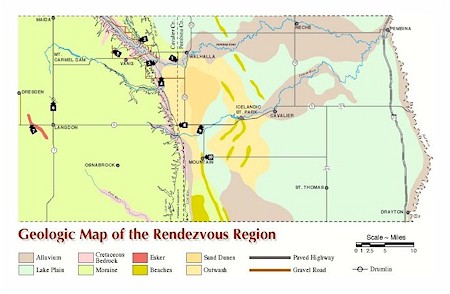
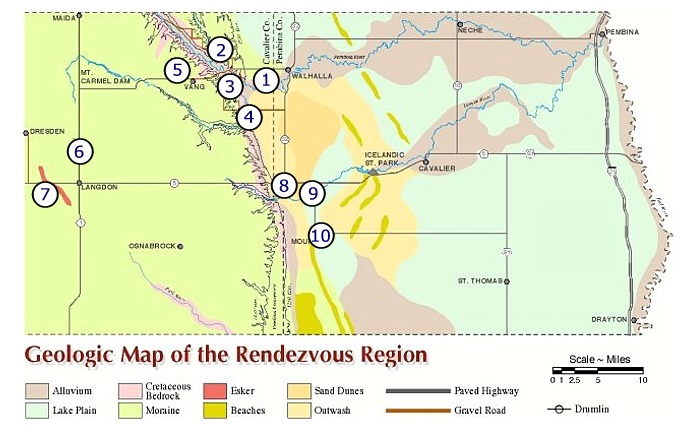
1 - Geology of the Rendezvous Region. This map shows in colors
where different rock formations are found in the Rendezvous Region.
Numbers and arrows on the map point out geologic features and
correspond to the numbered geology photographs of the features
included in this trunk. |
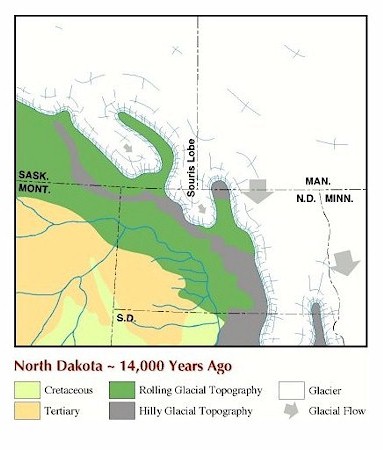
Nearly the entire surface of
Cavalier County consists of gently rolling to undulating terrain and
is underlain by sediments deposited during the last advance of glaciers
into the Rendezvous Region about 12,000 years ago (Map
2). Subtle landforms were produced by these glaciers.
The Pembina Escarpment, along the eastern edge of Cavalier County, marks
the eastern edge of this glaciated plain. East of the escarpment
is the Red River Valley, which is the former floor of glacial Lake Agassiz
that occupied the valley about 9,000 years ago (Map
3). The extremely flat Lake Agassiz basin terrain of Pembina
County, one of the flattest areas in the world, is interrupted in the
western part of the county by low, elongate hills that were Lake Agassiz
beaches. |
| |
|
| Map
2 - Geologic map of North Dakota 14,000 years ago. |
Map3
- Geologic map of North Dakota 11,000 years ago. |
|
Cretaceous
rocks that underlie the glacial deposits in the Rendezvous Region are
exposed where rivers, primarily the Pembina River and its tributaries,
have cut through the glacial deposits, primarily in the Pembina Gorge
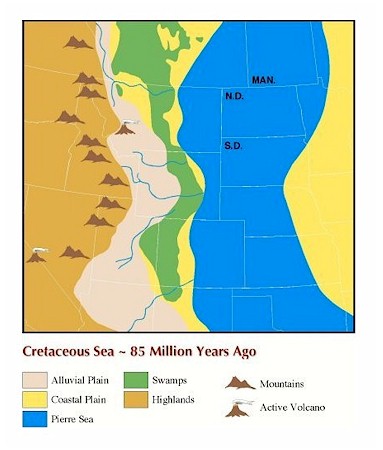
(Pembina Escarpment diagram). These Cretaceous
rocks were deposited in oceans that covered the area between about 90
million and 80 million years ago (Map 4). The
rocks contain fossils of the animals that lived in those oceans.
|
|
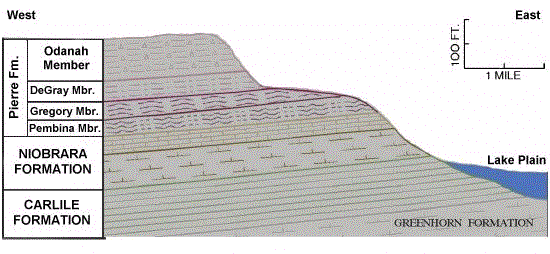
| Cross
Section 1: Pembina Escarpment Cross Section
of the Cretaceous rocks exposed along the Pembina Escarpment
in the Rendezvous Region. This profile
of the Pembina Escarpment shows the gently westerly-dipping bedrock
formations. The harder, more resistant Odonah Member of
the Pierre Formation keeps the escarpment from being eroded to
a more gentle feature.
|
|
|
|
Map
4 - Cretaceous Sea - 85 Million Years Ago.
|
|
|
|
|
Pembina
River Gorge Overlook |
|
| |
Geology
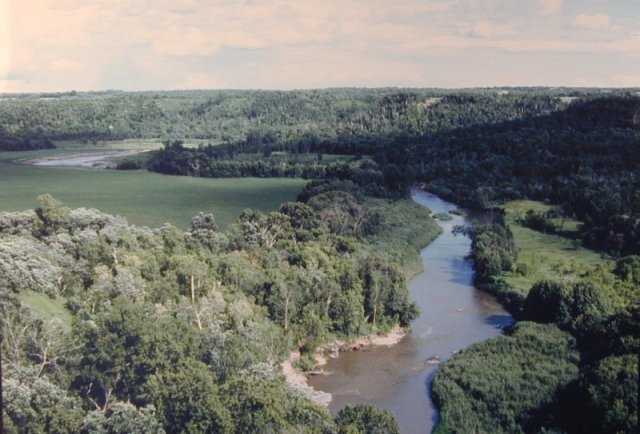
Site 1 - The Pembina River has eroded through glacial sediments
and Cretaceous bedrock to form the Pembina Gorge, one of
the most scenic areas in North Dakota. View is to the southeast
from Tetrault Overlook west of Walhalla. |
|

|
|
| |
| |
Geology
Site 2
- At this road cut, the Cretaceous Niobrara Formation is overlain
by the Pembina Member, the lowermost member of the Pierre Shale in
the area. These rocks were laid down in oceans that covered
most of North Dakota about 84 million years ago. The Niobrara
consists of light-gray to yellowish-tan, blocky, calcareous marl.
Fossils of ammonites, clams, fish (including sharks teeth), and sea
turtles have been found in the Niobrara in the Rendezvous Region.
The Pembina Member is a soft, black, noncalcareous shale that contains
gypsum. It also contains numerous beds of yellowish-white bentonite
clay (altered volcanic ash derived from volcanoes active in western
Montana at that time), particularly at its base. The contact
between the Niobrara and Pierre Formations is beneath the lowest bentonite
band. Fish and mosasaur (large marine reptiles) remains have
been found in the Pembina Member. This site was a promising
fossil site until it was destroyed by road construction activity in
1996. Because this site is located on land owned by the State
of North Dakota, destruction of the site violated North Dakota’s Paleontological
Resource Protection Act. Collecting of vertebrate fossils at
this site and any site on State of North Dakota land is prohibited
without a permit issued by the North Dakota Geological Survey.
View is to the west. |
|
|
|
Exposures
of the Carlile Formation
in Pembina Gorge
|
| |
| |
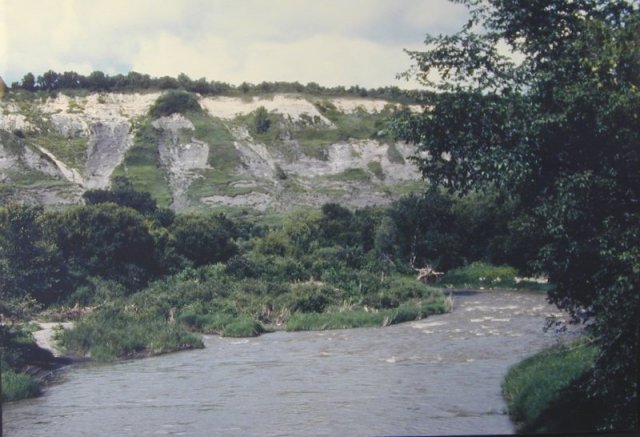
Geology
Site 3
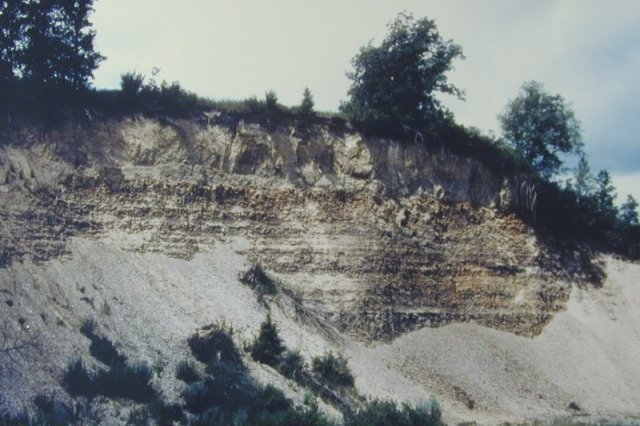
- The Cretaceous-age, 90-million-year old, Carlile Formation
is well exposed in this area of the Pembina Gorge. The Carlile
Formation consists of soft, black, noncalcareous shale deposited in
an offshore marine environment. At this locality, the Carlile
is about 160 feet thick and is overlain by 30 feet of light-colored
Niobrara Formation. The Carlile contains fossil shells of invertebrate
animals and fish scales. It is the oldest rock formation exposed
in North Dakota. View is to the east |
|
|
|
Glacial
Erratics in Little South Pembina River |
| |
| |
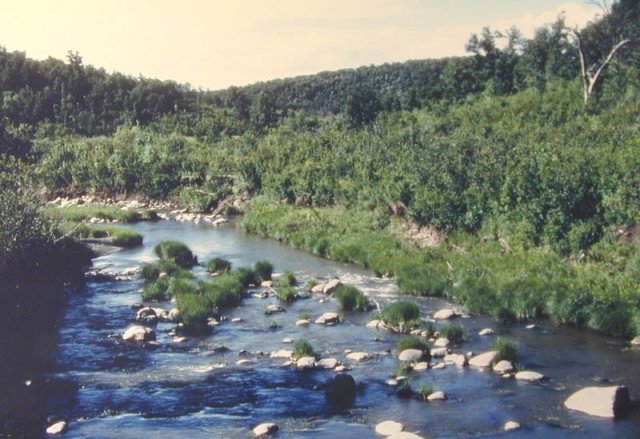
Geology
Site 4
- Glacial erratics, boulders carried to the Rendezvous Region by glaciers,
are seen on the upland, glaciated areas of Pembina County and in the
rivers. The composition of the erratics provides information about
where they came from and the direction the glaciers moved. View is
to the north. |
|
|
|
Exposures
of the Odanah Member of the Pierre Shale
in gravel pits |
| |
| |
Geology
Site 5
- The uppermost named member of the Pierre Shale, the Odanah Member,
is exposed in this gravel pit. It was deposited in a shallow-water
marine environment during the Cretaceous about 80 million years
ago. The Odanah Member is a hard, siliceous, light-gray shale.
Because of its hardness, it forms conspicuous cliffs and is quarried
for road surfacing material. Fossils are scarce in the Odanah
although oyster fossils have been recovered. View is to the
northwest. |
|
|
|
| |
|
| |
Geology
Site 6
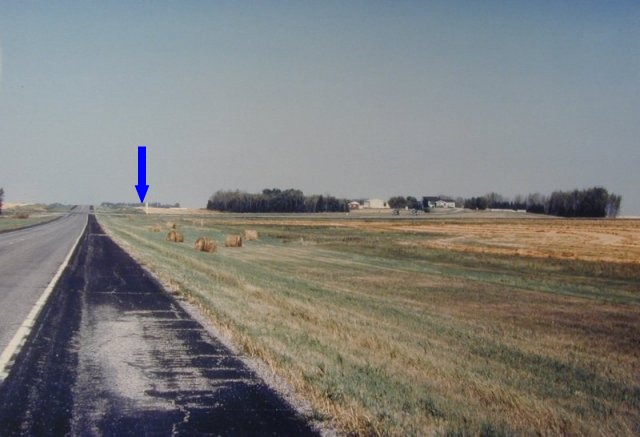
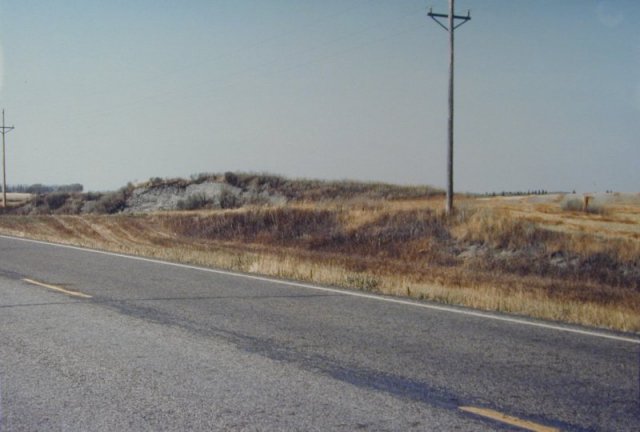
- Highway 1, four miles north of Langdon, cuts through a northwest-southeast
trending, elongate hill called a “drumlin.” Drumlins are streamlined
hills that were molded beneath sliding glaciers. The position of the
drumlin indicates that the glacier flowed from the northwest to the
southeast. View is to the north. |
|
|
|
|
|
| |
Geology
Site 7
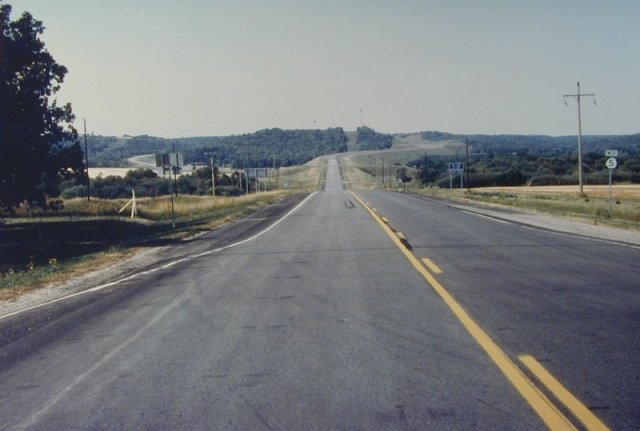
- Highway 5, four miles west of Langdon, cuts through a long, northwest-southeast
trending, sinuous ridge called an esker. Eskers consist of sand and
gravel that were deposited in streams and rivers that flowed in tunnels
and cracks in glaciers. View is to the northwest. |
|
|
|
|
| |
| |
Geology
Site 8
- The Pembina Escarpment, an-east facing scarp that extends for many
miles south of the Rendezvous Region, abruptly rises more than 250
feet above the glacial Lake Agassiz plain. Most of the escarpment
consists of relatively soft Cretaceous marine shales which were eroded
to initially form the scarp. Glaciers moving southward into
the Red River Valley scoured the face of the scarp. The hard,
resistant Odanah Member of the Pierre Shale, which occurs near the
top of the escarpment, prevents rapid erosion of the scarp. View is
to the west. (See Pembina Escarpment cross
section diagram) |
|
|
|
Sand
Dunes West of Cavalier |
| |
| |
Geologic
Site 9
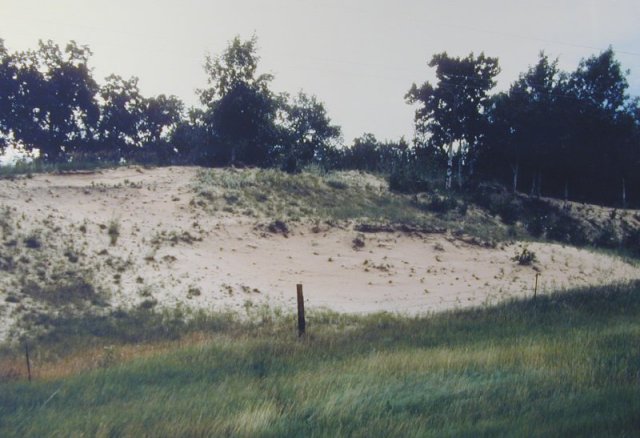
- Highway 5, about 11.5 miles west of Cavalier, cuts through sand
dunes. These dunes were formed by winds transporting and depositing
sediments derived from the Pembina Delta. The delta was formed where
the ancient Pembina River emptied into glacial Lake Agassiz about
10,000 to 9,000 years ago. These sand dunes also began to form
several thousand years ago. View is to the north.
|
|
|
|
Campbell
Beach Ridge at Mountain |
| |
| |
Geology
Site 10
- The town of Mountain is built on one of the beaches, called the
Campbell beach ridge, that formed along the shore of glacial Lake
Agassiz about 10,000 years ago. The Campbell beach ridge represents
a still stand of the water level in Lake Agassiz that probably lasted
about 100 years. The Campbell beach ridge can be traced around
the Red River Valley and is present on both the western and eastern
sides of the Lake Agassiz plain in North Dakota and Minnesota.
View is to the west. |
|
|
|
PALEONTOLOGY
Introduction:
Paleontology
is the study of ancient life (fossils) in contrast to biology the study
of modern life. Fossils (from the latin word fossilis which means
digging or to dig up) are the remains (shells, bones, etc.) or traces
(tracks, burrows, etc.) of plants and animals preserved by natural causes
in the Earth's crust (rocks, sediments, ice, lava, etc.). Although
this definition appears rather straight forward it is not because some
paleontologists believe that the remains must be prehistoric (at least
5,000 years old) before the remains should be considered fossils.
Other paleontologists would apply a broader definition and include remains
of plants and animals from historic times as fossils.* The definition
of a fossil excludes objects constructed by humans which are called artifacts
(arrowheads, pottery, baskets, houses, etc.). Artifacts are studied
by archeologists not paleontologists.
*"If
they stink, the remains belong to zoology, but if not, to paleontology."-Carl
O. Dunbar
Paleontology
is generally considered a sub-discipline of geology although many paleontologists
have college degrees in one of the biological sciences. Most
paleontologists are specialists and restrict their studies to a
specific group of fossils such as clams, dinosaurs, sharks, leaves, insects,
etc. Paleontologists study fossils to determine
the kinds of plants and animals that inhabited the Earth at different
times in the geologic past. Fossils are our primary means of documenting
the history of life on Earth and should be viewed as objects of
great scientific and educational value. Fossils also provide
information about the types of climates and environments that existed
in the past, and they are used to date and correlate rock
units.
Paleontology
of the Rendezvous Region:
Rocks
of the Carlile, Niobrara, and Pierre Formations are exposed in road cuts
and along rivers in the Rendezvous Region. These rocks were deposited
in subtropical to warm temperate seas, the Western Interior Seaway, which
covered North Dakota during Late Cretaceous time from about 90 million
to 80 million years ago (Map 4). Fossils of
animals and plants that inhabited those seas are entombed in these rocks.
Remains of marine reptiles (mosasaurs, plesiosaurs, and turtles), fish
(including sharks), and invertebrates (including clams, cephalopods, snails,
corals, and crabs) have been recovered from the rocks.
Remains
of plants and animals (including the woolly mammoth) that lived
during the last Ice Age a few thousand years ago (Map
3) are also found in the Rendezvous Region.
|
|
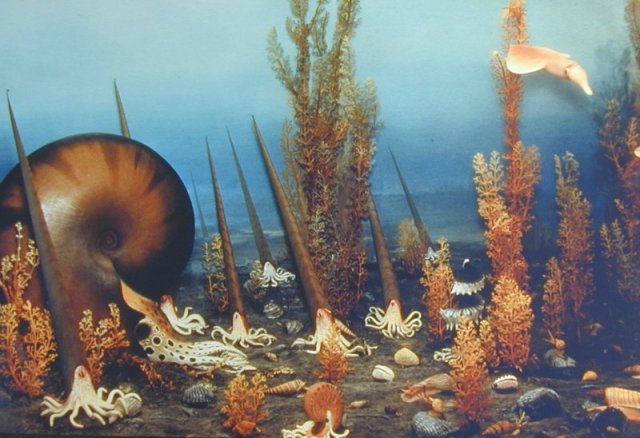
| CRETACEOUS
OCEAN FLOOR COMMUNITY
This picture of a diorama in the Smithsonian Institution shows
many of the invertebrate animals that lived, at least part of
the time, on the floor of the ocean that covered the Rendezvous
Region during the Cretaceous. |
| |
|
|
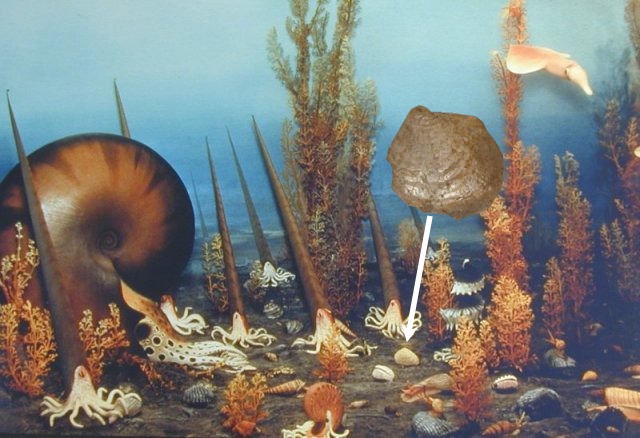
Clam
shell, Inoceramus, from the Pierre Shale
Width 6 inches |
Snail,
Euspira, from the Pierre Shale
Height .5 inch |
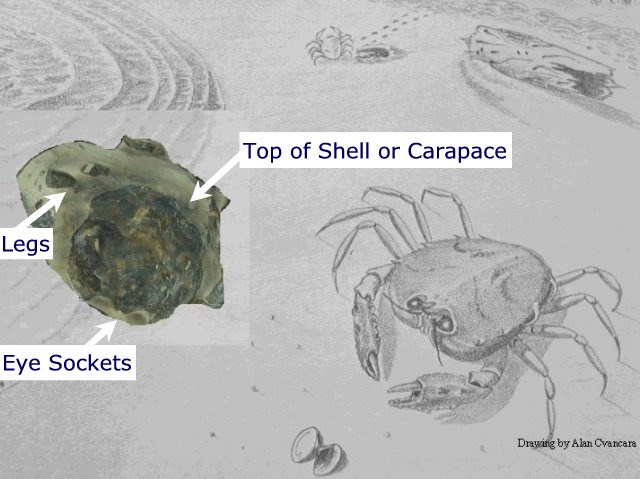
Crab,
Dakoticancer overanus, from the Pierre Shale
Width .75 inch |
|
| |
|
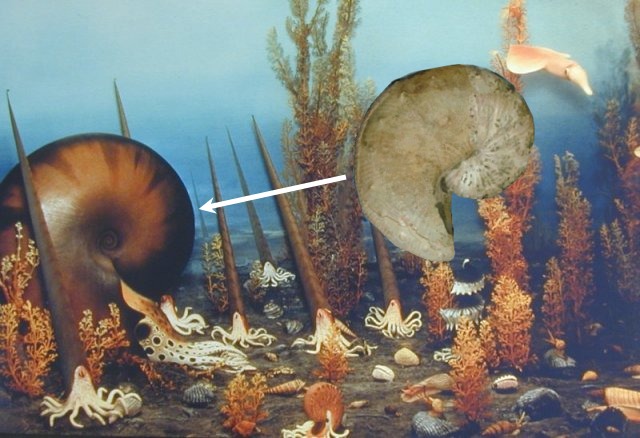
Cephalopod,
Jeletzkytes, from the Pierre Shale
Height 4 inches |
Cephalopod,
Baculites, from the Pierre Shale
Height 4 inches |
|
|
|
CRETACEOUS
OCEAN COMMUNITY
This picture of a mural in the Pembina Sate Museum shows
many of the animals that inhabited the Western Interior Seaway that covered
the Rendezvous Region during the Cretaceous. The picture is based
on fossils found in North Dakota.

|
|
Key
to habitat reconstruction mural:
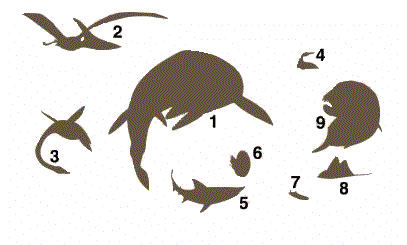
1) Mosasaur (Plioplatecarpus), a marine reptile; 2) Pterosaur,
a flying reptile; 3) Plesiosaur, a marine reptile; 4) Seabird (Hesperornis);
5) Sand-tiger shark (Carcharias); 6) Cephalopods; 7) Salmon-like
fish (Enchodus); 8) Rays;
9) Tarpon-like fish (Xiphactinus) |
|
Hesperornis |
| |
|
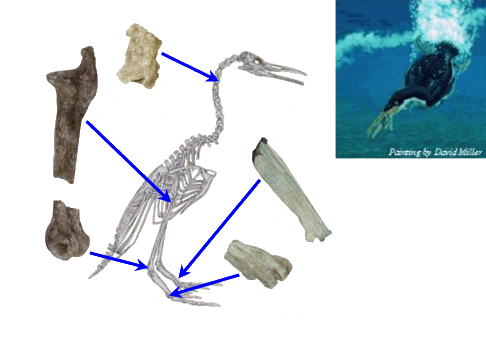
| Skeletal
diagram of Hesperornis. From Carroll, 1988
5 feet tall |
Painting
of Hesperornis diving
Hesperornis was a large, up to about five-foot-tall, flightless
seabird. It was equipped with sharp, pointed teeth and probably
preyed on fish and squids underwater. Although it was incapable
of flight, Hesperornis was a swift swimmer that could propel
itself through the shallow coastal waters of the Pierre Sea with
its powerful hind legs. Painting by Dan Varner. |
|
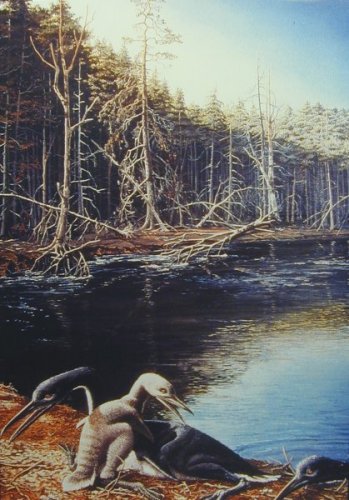
| Painting
of an adult Hesperornis and hatchling on the shore of the
Pierre Sea |
|
| |
Although
Hesperornis was a diving seabird it would lay eggs on land.
Painting by Eleanor Kish |
|
|
| |
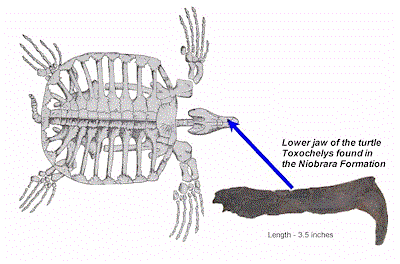
Toxochelys |
|
|
| Diagram
of the skeleton of a marine turtle, 8
feet long
(From
Carroll, 1988). |
Painting
of marine turtles being preyed on by a meat-eating dinosaur. Painting
by Mark Hallett |
|
|
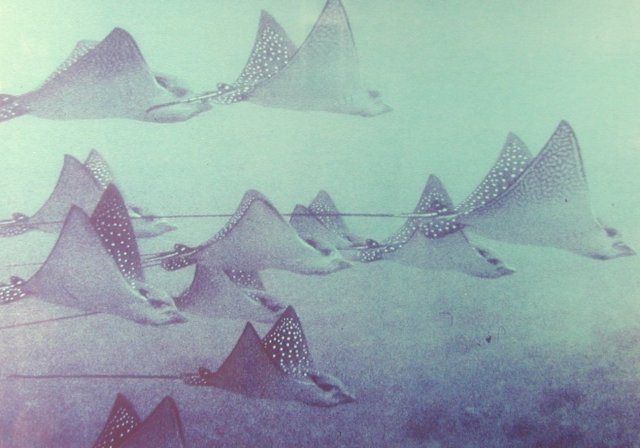
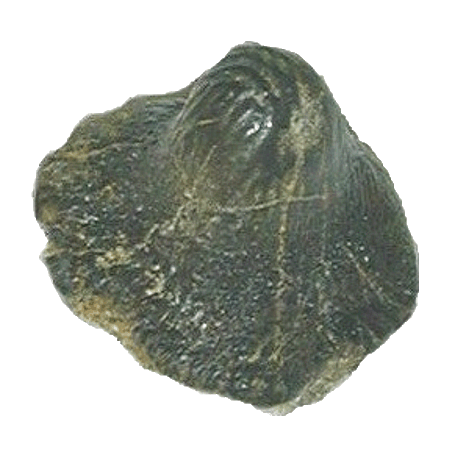
Ptychodus |
|
|
| Ptychodus
was similar to the living eagle ray shown in this picture. |
Tooth
of Ptychodus. Width .50 inch |
|
|
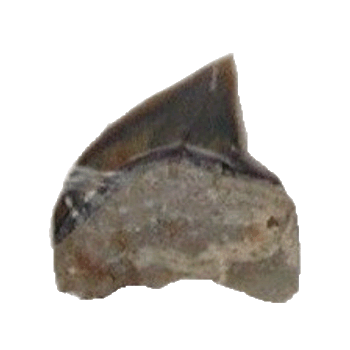
Squalicorax |
|
|
Tooth
of the shark, Squalicorax.
Width .75 inch. |
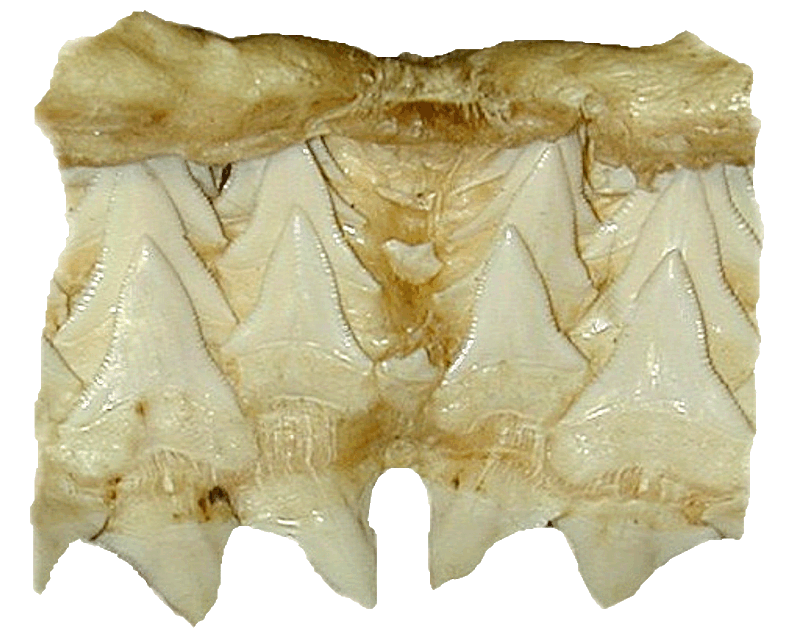
Squalicorax
had rows of teeth in its jaws like living sharks as shown in the
picture above. A shark produces and sheds thousands of teeth
throughout its lifetime. |
|
|
 |
Painting
of the living sand-tiger shark, Carcharias taurus
Several
kinds of sharks inhabited the Western Interior Seaway during the
Cretaceous in the Rendezvous Region including a variety that was
very similar to the living sand-tiger shark, Carcharias taurus
shown in this painting. Painting by Richard Ellis
|
|
|
Plesiosaur |
| |
|
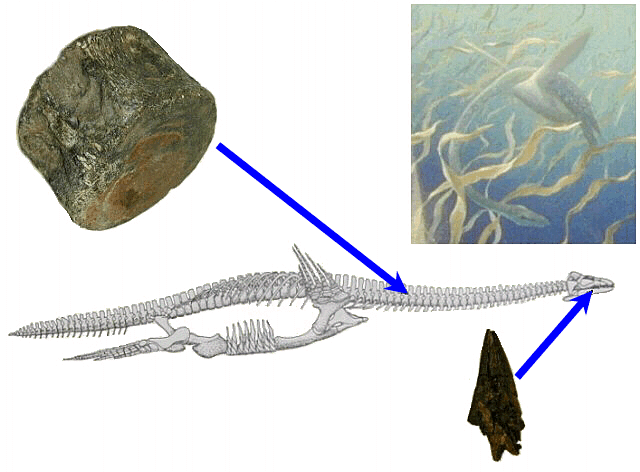
| Skeletal
diagram of the large marine reptile called a plesiosaur
From Carroll, 1988 40 feet long |
Painting
of a Cretaceous underwater scene featuring a long-necked plesiosaur.
This painting of a Cretaceous
marine habitat features one of the marine reptiles called a plesiosaur.
Plesiosaurs grew to lengths of 40 feet or more. Plesiosaurs
and mosasaurs were the main predators that lived in the Cretaceous
seas. Another predator, a shark, is also shown in the painting.
Plesiosaurs were not dinosaurs but became extinct at the same time
as the last of the dinosaurs. Painting by Vladimir Krb
|
|
|
Stratodus
apicalis |
| |
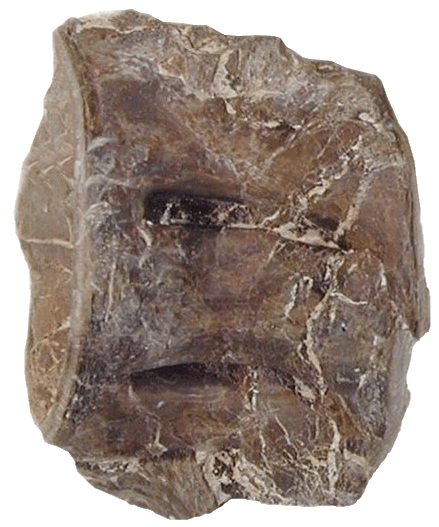
Vertebra
from the barracuda-like fish, Stratodus apicalis, found in
the Pierre Shale. Width 1.5 inches |
|
|
Xiphactinus |
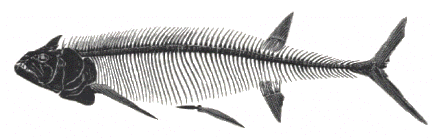
Diagram
of the skeleton of Xiphactinus
|
|

Lower
jaw of the tarpon-like fish, Xiphactinus, found in the
Pierre Shale. Height 7 inches
|
| |
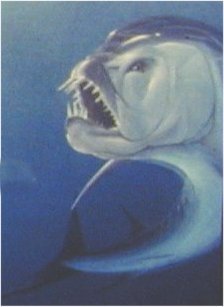
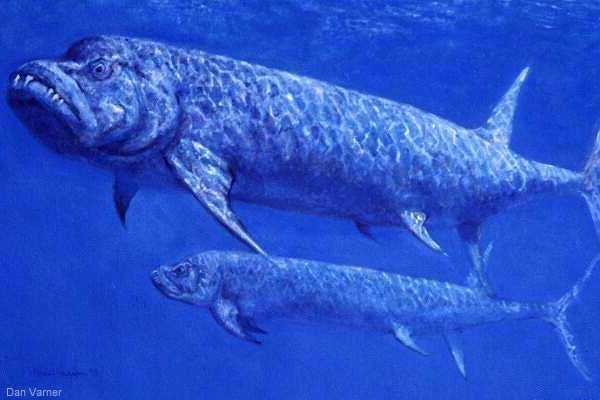
Painting
of Xiphactinus
The tarpon-like fish, Xiphactinus, was one
of the largest fish that inhabited the Pierre Sea. It grew to
lengths of eighteen feet. Their large size, elongate bodies,
powerful tails, and bulldog-like jaws suggest that they were efficient
predators. Xiphactinus had large fangs at the front of the
mouth probably used to strike or impale prey during initial attach.
Painting by Dan Varner. |
|
|
| Plioplatecarpus |

Skeletal
diagram of . Modified
from Carroll, 1988. 25 feet long |
 |
| Painting
of Plioplatecarpus |
| The
mosasaur Plioplatecarpus was one of the reptiles
that inhabited the Pierre Sea. Mosasaurs were huge
animals, some up to 30 feet long, with long lizard-like
bodies. Unlike their terrestrial lizard relatives,
the limbs of mosasaurs were modified to form flippers.
Mosasaurs swam by lateral undulations of the posterior part
of their bodies and laterally compressed tails. Their
flippers were used primarily for steering rather than for
propulsion as the animal glided through the water.
Mosasaurs were active predators and among the main carnivores
in the Pierre Sea. They probably preyed on other mosasaurs,
fish, turtles, and invertebrates. Although mosasaurs
were not dinosaurs, they became extinct at the same time
as the dinosaurs about 65 million years ago. Painting
by Dan Varner. |
|
|
|
The
Rendezvous Region at the end of the Ice Age |
 |
This
picture of a mural in the Pembina State Museum is a scene of the
Rendezvous Region at the end of the Ice Age about 11,000 to 10,000
years ago. A glacier is present in the back ground and glacial
Lake Agassiz is forming in front of the glacier as the glacier melts.
At this time, the Rendezvous Region was inhabited by woolly mammoths
and bison. The first people to live in North Dakota migrated
here about this time. They hunted the big game for food and
clothing. |
|
|
|
|
EXHIBITS:
Exhibits of fossils of the prehistoric life
that inhabited the Rendezvous Region can be seen at the North
Dakota Heritage Center, Bismarck; Pembina State Museum, Pembina;
Icelandic State Park, Cavalier; Cavalier County Museum, Dresden;
and the Morden Museum, Morden, Manitoba.
The
Rendezvous Region Traveling Education Trunk is a cooperative
project between the
North Dakota Geological Survey,
North Dakota Parks and Recreation Department,
and
State Historical Society of North Dakota.
|
|
|
|
|